Friday, June 30, 2006

A Diagram to Better English


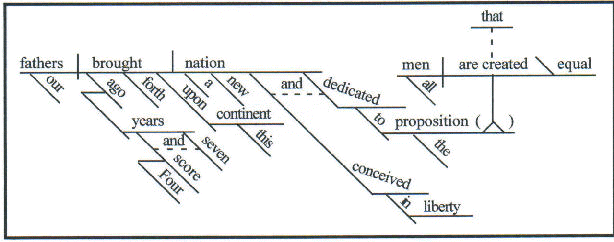
The Gettysburg Address


Eugene R. Moutoux, a retired English teacher, has a marvelous site on diagramming sentences. Above is a gem from his diagramming of sentences from historical documents. Moutoux's work can also be found here and here

Maybe ACES could offer a diagramming contest at its next conference.

Heads Up the Blog has a good posting on why diagramming matters.

Thursday, June 29, 2006

Enough Is Enough.

The San Francisco Chronicle says talk show host Melanie Morgan believes that Times editor Bill Keller should be jailed for treason for approving the publication.

The maximum penalty for treason is death.

"If he were to be tried and convicted of treason, yes, I would have no problem with him being sent to the gas chamber," Morgan, whose show airs on KSFO-AM, told The Chronicle on Wednesday. "It is about revealing classified secrets in the time of war. And the media has got to take responsibility for revealing classified information that is putting American lives at risk."

Wednesday, June 28, 2006

B#$A*()D W*$O^*R#$D@!S

Favorite Question, from the Chicago Manual of Style

Q. Is there a standard for replacing an expletive with special $%!# characters?

A. Although there isn’t a steady demand for masked expletives in scholarly prose, this is weirdly one of our frequently asked questions. (I have to wonder who is reading the Q&A—and what they are writing.) The symbols are fine for cartoons and e-mail messages, where you may arrange them in whatever order pleases you. In formal prose, however, we find that a 2-em dash makes a d——d fine replacement device.

Speaking of $#%*(@ bad language, has anyone noticed how crude Spanish words are creeping into TV shows? Last night, one of those CSI or NCSI or something shows on network TV had a character use the word "pendejo" without blinking an eye. Is anyone checking those scripts?
Print is not exempt--a paper I was once associated with used a Spanish term that Puerto Ricans translate as "jackoff" in a story explaining how it was a clue as to the origins of some criminals.

Arrrghh...

From the often-amusing, peripatetic Office Pirates, we are reminded of how trite our headlines can be.

This may sum up the problem the best:

Box Office Headlines: "Original Ideas Just Can't Seem to Click"

Tuesday, June 27, 2006

Tracking Polls

Dan Froomkin of The Washington Post makes an excellent point about the effect of word choice in polling, one of the reasons polling stories should be handed with extreme caution. He puts up to polls with significant differences in results, and tracks back to the polls' questions to find out why they diverged. (That's not even getting to online polls, which serve no useful purpose beyond encouraging web hits. A subject for another day.)
But before you get to the poll, read his thorough assessment of the brouhaha over The New York Times' (and other papers) decision to publish information about the tracking of financial records.

When Your Newspaper Job Disappears...

..Maybe you could get a job editing signs.


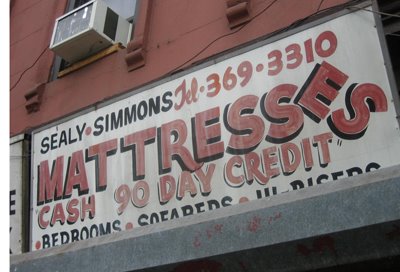
From Grammar Lounge


---


And from Scriptorium, another apostrophe problem. Note the comment on the site, snarkiest of the week. Very funny.

Time to call in the Apostrophe Protection Society


Ah, some more fun signs, from Kula


Monday, June 26, 2006

Ah. Some... Words.

Ruth Walker at the Christian Science Monitor has a fascinating piece about jurors, judges' instructions and vocabulary.
Here's part of what she says:
There are, after all, places where language is a matter of life and death. The deliberation room where a jury considers sentencing options in a capital case is one of them. ....
...One of the [conference] presenters remarked en passant that jurors, asked to determine whether a defendant found guilty of a capital crime should be given a life sentence or the death penalty, are instructed to consider "mitigating" or "aggravating" factors...

Quite often, he said, jurors don't really know what either of those words means....

[Jury instructions]... can be utterly baffling to jurors, researchers have found. Shari Seidman Diamond, at Northwestern University Law School, described one such set of instructions as "unconstitutionally incomprehensible," in a 1993 journal article called "Instructing on Death."

She quoted what she called a "quadruple negative" sentence from some legal language in use in Illinois:

"If you do not unanimously find from your consideration of all the evidence there are no mitigating factors sufficient to preclude imposition of a death sentence, then you should sign the verdict requiring the court to impose a sentence other than death." In lay terms: "To impose the death penalty, all jurors must agree that the defendant did something much worse than just plain murder."

In this universe, is it any wonder why a criminal defense lawyer like the late Johnnie Cochran would seize on a line like "If it doesn't fit, you must acquit"? It's easy to imagine how, amid the din of legal-speak, such an utterance would fall on the ears of a bewildered juror like a snatch of familiar melody tucked into an avant-garde composition.


Having just chatted with a middle school teacher frustrated with students' inability to get beyond exclaiming "awesome!" 20 times a day, I am intrigued by this and a study several months ago that described the decline in American speech in the last 40 years. While I can't find the study at the moment, it, as I recall, said that Americans are using ever-shorter sentences, often relying on quick, snappy one-liners, often borrowed from TV, as a substitute for dialogue. And, since I've spent a huge amount of time in the last couple of months watching cable news TV, the sloppiness of language, facts and ideas is truly scary. A minor detail: "Bill Gates said a couple of weeks back" that he was retiring. Well, he said it June 16, not that difficult to report. Yes, it's a very minor detail, but one easy to get right. Try watching cable TV news for a while and you'll see what I mean. The problem is exacerbated by a recent onslaught of especially bubbleheaded, bright-eyed women (What kind of lights are those studios using?) determined to act like giddy schoolgirls.
Where are we headed when advertising slogans and bad sitcom writing supplant educated conversation?

Time for Abate Gate

UPDATE July 18. Proof this battle has been lost.
From Jabal al-Lughat
Friday, June 09, 2006
"-gate" suffix reaches Arabic
Algerian football fans (that is to say, probably most of the population) are up in arms about not being able to watch the World Cup unless they subscribe to ART - a Saudi company which bought up the rights to World Cup footage for the MENA region and is selling it so expensively most terrestrial stations (including Algeria's) can't afford it. I don't particularly care myself, to be honest, but I was impressed to see the following headline in the newspaper Ech Chourouk:

الجزائر على أبواب فضيحة "آرتي-غايت"!


al-Jazaa'ir `alaa 'abwaab faḍiiħat "aartii-gaayt"!
(Algeria is on the verge of an ART-gate scandal!)


Perhaps nothing so illustrates the bankrupt state of journalism than its practitioners' inability to come up with a substitute word for '-gate' when referring to a scandal. OK, I'm exaggerating a little.

It's always possible the author of this construction intended it to be ironic. Or satirical. Who knows? But really folks, enough is enough. Headline writers, can't we set an example and come up with some better words?

If all else fails, how about a complete on-pain-of-death ban?

Here's the latest:
In fact, after a two-year exile following St. Patrick’s-gate, O&A have reemerged as perhaps the important players at the company that fired them, CBS Radio. CBS owns all the stations that have put them back on the air.

Think I'm kidding?

From Wikipedia:
The Watergate scandals left such an impression on the national and international consciousness that many scandals since then have been labeled with the suffix "-gate" — such as Koreagate, Contragate, Whitewatergate, Travelgate, "Zippergate" or Filegate in the U.S., Tunagate in Canada, Dianagate/Squidgygate and Thatchergate in the UK, and even Pemexgate and Toallagate in Mexico. The judging scandal in the pairs event at the 2002 Winter Olympics in which a controversial double gold medal was awarded to Russians Elena Berezhnaya & Anton Sikharulidze and Canadians Jamie Sale & David Pelletier was termed Skategate.

The worst part is that "gate" has spread around the world.

And a few others, from
Wikipedia's lesser known scandals. :

Bananagate — 1975 scandal, in which Oswaldo López Arellano, President of Honduras, accepted a $1.2m bribe from US firm United Brands to halve the banana export levy

Cheriegate — concerning Cherie Blair's association with Carole Caplin, and through her to the convicted fraudster Peter Foster."Curse of 'Cheriegate' strikes again", The Scotsman, 2005-06-18.

Clarkegate — In the UK on April 2006 it was revealed Home Secretary Charles Clarke had failed to deport over 1,000 foreign criminals.

Corngate — The accidental release of genetically modified corn in New Zealand. "Straight Thinking", Truth about Trade and Technology, 2005-06-28.

Debategate — Acquisition of Jimmy Carter's briefing books by Ronald Reagan's team before the presidential debates during the 1980 campaign.

Fajitagate — In November of 2002, three off-duty San Francisco police officers allegedly assaulted two civilians over a bag of steak fajitas.

Gannongate — United States President George W. Bush's White House scandal involving free press conference passes for conservative James Dale Guckert under the false pseudonym Jeff Gannon "Gannongate threatens to expose a huge GOP pedophile and male prostitution ring", Online Journal, 2005-02-18.

Garbagegate, a 2005 scandal in San Jose, California, involving Mayor Ron Gonzales, and a under-the-table deal with the Norcal garbage company.

Jueteng-gate — Scandal involving Philippine president Joseph Estrada alleging that he amassed millions of dollars from an illegal numbers game called jueteng. As a result, he was deposed through a popular uprising.

Koreagate — South Korean businessman Tongsun Park's shady dealings with certain members of Congress (1976)."WIU professor fought abuse in native Korea", Journal Star, 2005-07-12.

Michaelgate — the supposed conspiracy against Michael Jackson that led to the 2005 trial of Michael Jackson. Was written about in a book by author Geraldine Hughes titled, "Michaelgate: The Conspiracy Theories".

Oilgate — the alleged use of PetroSA funds for African National Congress election campaigns "Oilgate: UN probes Iraq deals", Mail and Guardian, 2005-07-08.

Paksagate (Paksageitas) — Impeachment of president Rolandas Paksas of Lithuania

Pardongate — President Clinton's presidential pardons "Dick Morris: Hillary Surging, Thanks to GOP", NewsMax, 2005-06-21.

Phonegate — used for multiple scandals: in Minnesota in the early 1990s, New Hampshire in 2002, and Macedonia in 2004

Pretzelgate — To explain a two-inch bruise on the face of U.S. President George W. Bush, he and his staff claim he hit his face on a coffee table after passing out because he choked on a pretzel.

Quailgate — Describes a scandal when U.S. Vice President Dick Cheney accidentally shooting Harry Whittington during a quail hunt (see Dick Cheney hunting accident, February 2006). See also Shot in the Face-gate and Fudd Gate.

Sausagegate - 2003 incident in which Randall Simon hit a Milwaukee Brewers mascot with a bat during the "Sausage Race."

Skategate — the scandal over the pairs figure skating results of the 2002 Winter Olympics in Salt Lake City, where a judge was apparently bribed to fix the outcome. The case went on for nearly two weeks before joint gold medals were granted.

In their own special state of triteness:

Strippergate — Seattle City Council members Heidi Wills and Judy Nicastro vote for rezoning a strip club parking lot in exchange for unethical donations. " Four face charges in 'Strippergate' scandal", Seattle Post-Intelligencer, 2005-07-12.

Strippergate — A scandal in Canada in 2004 with the Minister of Immigration Judy Sgro accused of granting a visa to a Romanian exotic dancer who worked for her campaign during the 2004 federal election.

Strippergate — San Diego City Council Members Michael Zucchet and Ralph Inzunza are, in 2005, convicted of accepting bribes from a strip club owner in a scheme to get the "no-touch" laws in San Diegan strip clubs repealed. The case was referred to with this name by at least one local television news station in San Diego.
Tunagate — In 1985, a Canadian minister ordered the selling of tuna ruled unfit for consumption.

Whitewatergate — In 1994, President Bill Clinton and his wife Hillary were charged with covering up shady investments.

Wikigate — candidates editing wikipedia for political gain e.g. (The Scotsman)

Sunday, June 25, 2006

Focus, People, Focus

John Rains at his Writing Coach web site has been offering good advice on writing tight and finding the focus. And he's taken a quick comment from me and produced a thoughtful, highly practical piece, which includes this nugget:
If you can get to the core of the story in a six- word headline, you surely have a good handle on it. If you can’t, you are probably still struggling to figure out the angle. Whatever you have written isn’t ready to be sent out to the world.

Friday, June 23, 2006

Alternatives

Attributed to The Washington Post:

Once again, The Washington Post has published the winning submissions to its yearly contest, in which readers are asked to supply alternate meanings for common words.

The winners are:

1. Coffee (n.), the person upon whom one coughs.

2. Flabbergasted (adj.), appalled over how much weight you have gained.

3. Abdicate (v.), to give up all hope of ever having a flat stomach.

4. Esplanade (v.), to attempt an explanation while drunk.

5. Willy-nilly (adj.), impotent.

6. Negligent (adj.), describes a condition in which you absentmindedly answer the door in your nightgown.

7. Lymph (v.), to walk with a lisp.

8. Gargoyle (n.), olive-flavored mouthwash.

9. Flatulence (n.) emergency vehicle that picks you up after you are run over by a steamroller.

10. Balderdash (n.), a rapidly receding hairline.

11. Testicle (n.), a humorous question on an exam.

12. Rectitude (n.), the formal, dignified bearing adopted by proctologists.

13. Pokemon (n), a Rastafarian proctologist.

14. Oyster (n.), a person who sprinkles his conversation with Yiddishisms.

15. Frisbeetarianism (n.), (back by popular demand ): The belief that, when
you die, your Soul flies up onto the roof and gets stuck there.

16. Circumvent (n.), an opening in the front of boxer shorts worn by Jewish men.

The Washington Post's Style Invitational also asked readers to take any word
from the dictionary, alter it by adding, subtracting, or changing one letter, and supply a new definition. Here are this year's winners:

1. Bozone (n.): The substance surrounding stupid people that stops bright
ideas from penetrating. The bozone layer, unfortunately, showslittle sign of breaking down in the near future.

2. Foreploy (v): Any misr epresentation about yourself for the purpose of getting laid.

3. Cashtration (n.): The act of buying a house, which renders the subject
financially impotent for an indefinite period.

4. Giraffiti (n): Vandalism spray-painted very, very high.

5. Sarchasm (n): The gulf between the author of sarcastic wit and the person
who doesn't get it.

6. Inoculatte (v): To take coffee intravenously when you are running late.

7. Hipatitis (n): Terminal coolness.

8. Osteopornosis (n): A degenerate disease. (This one got e xtra credit.)

9. Karmageddon (n): It's like, when everybody is sending off all these really bad vibes, right? And then, like, the Earth explodes and it'slike, a serious bummer.

10. Decafalon (n.): The grueling event of getting through the day consuming
only things that are good for you.

11. Glibido (v): All talk and no action.

12. Dopeler effect (n): The tendency of stupid ideas to seem smarter when
they come at you rapidly.

13. Arachnoleptic fit (n.): The frantic dance performed just after you've
accidental ly walked through a spider web.

14. Beelzebug (n.): Satan in the form of a mosquito that gets into your
bedroom at three in the morning and cannot be cast out.

15. Caterpallor (n.): The color you turn after finding half a grub in the
fruit you're eating.

And the pick of the literature:

16. Ignoranus (n): A person who's both stupid and an asshole.

Thanks to Stephen Murray
Thursday, June 22, 2006

Oops Times Three

Favorite recent corrections, from Regret the Error

From The New York Times:

He haunts them still
The public editor's June 18 column incorrectly indicated that Jayson Blair, the former Times reporter who brought scandal to the paper in 2003, didn't receive performance evaluations during his time on the metro desk during 2001-2. Mr. Blair was evaluated and an evaluation was specifically provided to the sports editor when the reporter was moved to the sports department. But no evaluations of Mr. Blair's work on the metro desk, then one of the few departments doing regular formal performance assessments, were reviewed by the editors involved when the reporter subsequently was deployed to the national desk.
---
Miami Herald
Mark Cuban recently wrote on his blog that, contrary to what was reported in a Miami Herald column, he did not say that the NBA was rigged, nor did he swear at league commissioner David Stern. Yesterday the Herald published a correction that admitted the comments attributed to Cuban came from a secondary source and "may not have been accurate." Makes you wonder what the paper's source is saying now, and why the paper didn't fully correct the report or choose to stand behind it. The result is a rather unconvincing correction. The correction:

A comment by Dallas Mavericks owner Mark Cuban that appeared in Greg Cote's column Tuesday on Page 7NB was obtained from a secondhand source and could not be verified and may not have been accurate. Cuban was quoted as yelling a profanity and saying the league was rigged to NBA Commissioner David Stern and league officials at the end of Game 5 of the NBA Finals on Sunday night in Miami. Cuban on Tuesday said on his Web log he did not say anything to Stern after Game 5. Cuban also said on his blog that any inference that NBA games are rigged is "nonsense.'' Link
---

Ottawa Citizen (Natural) death to the traitor!
An editorial yesterday misstated the fate of legendary traitor Benedict Arnold. He was not hanged, but died of natural causes in Britain in 1801

(Dumb) Pictures on a Page

The proprietor of
Heads Up, the blog
* has been writing some really smart stuff about how we do journalism, or at least, produce pages, edit stories and slap on heads. This piece about a design idea overrunning common sense is especially worth a careful read.

*Though I don't really know what a "thort" is.

Lijit Ad Tag